
Guide: a website for a beauty salon
- who is qualified
- portfolio and consent
- prices
- online booking
- the Google listing
Who is legally allowed to open a salon in France, what you can write in a service description, what online booking really costs, and what you need to know about before/after photos.
What you get
Who is qualified to practise; portfolio and image rights; the team; prices and quotes; online booking and its cost; templates with examples; the Google listing for a salon; reviews; languages; what AI genuinely helps with; the pre-launch checklist
In a beauty salon it is not the copy that convinces a client, it is the photo of the practitioner’s work. But before talking about layout, it is worth settling what costs money and reputation: who is legally allowed to provide the service in France, what can be written in a description, and how to use a client’s photo without breaking the law.

Who is allowed to open a salon and provide the service
Hairdressing is regulated on its own in France, and has been for a long time: the founding law no. 46-1173 of 23 May 1946, amended by law no. 96-603 of 5 July 1996, spelled out by decree no. 2017-767 of 4 May 2017. Under the rule in force, a salon must employ at least one person holding a brevet professionnel, a brevet de maîtrise, or a diploma of at least that level on the national register of professional qualifications. You cannot open a salon on a bare CAP — but you can open one without a personal diploma if at least one employee or partner holds that qualification. A separate rule covers house calls: a hairdresser visiting a client at home must hold the CAP coiffure.
Beauty and body care have no such barrier — a nail, brow or waxing studio can open with no diploma at all. But there is a wording trap: the word “massage” is legally reserved for kinésithérapeutes, physiotherapists holding a state diploma. An esthetician has to write “modelage esthétique”. A 2021 ruling of the Cour de cassation softened the rule for wellness practices, but only where there is no confusion with therapeutic massage. Check the wording on your own service menu — it is the commonest mistake on beauty studio websites.
Professional liability insurance is not required by law for a hairdresser or an esthetician — this is not the same situation as for a doctor or a lawyer. But in practice the landlord of the premises often asks for it, and after the first dispute with a client, going without it is something you regret.
Portfolio and image rights for clients
A portfolio is not decoration on a salon website, it is the main argument. But a before/after shot shows a real person’s image, and under French law an image counts as personal data — it falls under droit à l’image.
The rule is simple: the client’s written consent before publication, describing where and for how long the photo will be used, with the client free to withdraw that consent at any time. A spoken “sure, go ahead” is not enough — in a dispute, proving consent is on you. For a minor, written consent from a parent or guardian is required.
In practice this is settled with one piece of paper: a short consent form at the till or in the booking app, which the client signs right after the service, while the result is in front of them and it is easy to ask. Keeping the signed consents matters — that is your evidence, not a box-ticking formality.
The team: how to show trust
If a client picks a practitioner rather than a sign, one thing follows directly: the site has to show the practitioners themselves, not only their work. A first name, a specialty — colourist, barber, extension specialist — and a couple of lines of experience. A photo of the person, not just of their hands at work.
The diploma and the qualification are not a box-ticking formality — they are worth showing directly. “Certified hairdresser, BP Coiffure” is concrete trust; “professional team” is words nobody believes. For a salon operating under a legal qualification requirement, that is also an honest argument: you are not the only one writing “professionals”, but you can back it up.
Prices and quotes
For hairdressing salons, prices are not a nicety but a requirement of the order of 27 March 1987. Prices for at least ten of the most common services must be visible from outside if the salon serves everyone, or twenty — ten each — if it is split into a men’s and a women’s side. The fine reaches €3,000 for an individual and €15,000 for a company. The requirement is about the sign in the salon, but since it exists anyway, it makes sense to show the same prices on the site rather than leave the client guessing.
On the site, give at least a “from” price for every service: “cut from €35”, not a vague “ask us”.
If the final price depends on hair length, the amount of work or the products used — which is almost always the case in hairdressing and extensions — say so on the site in advance. A detailed quote is not always compulsory, but it is on the client’s explicit request when the price cannot be fixed beforehand; a receipt is due on request for services over €25 including tax. Work it out on the spot, before starting the service — that protects both the client and you: a dispute over price after the fact rarely gets settled in the salon’s favour.
Online booking: what it really costs
For a salon, booking without phone calls is not a luxury: it saves reception time and does not lose the clients who write late at night. There are three options on the French market, and they are priced differently. Checked as of August 2026.
Planity — a fixed subscription, €74 to €114 a month depending on features (calendar only, calendar plus till, the full package), with no commission on bookings. The market leader in France among hairdressers and beauty studios.
Treatwell — charges 25% on the first booking of every new client who comes from their platform, and 0% on all their later visits. The model works as a fee for acquisition, not for the tool.
Fresha — a hybrid: a subscription plus roughly 20% on new clients coming through the Fresha marketplace, plus a separate payment fee of around 1.3–3.3%.
The difference is structural. Planity is predictable and pays off with a steady stream of regulars. Treatwell and Fresha are better value for a new salon with no client base of its own — you only pay for the clients the platform genuinely brought. If you have just opened, it makes sense to start with a pay-per-result platform rather than a fixed subscription.
The Google listing: booking and the salon-specific details
The general mechanics of the listing — name, category, verification, reviews — are covered in the dedicated guide, and we will not repeat them here. What is specific to a salon comes down to two things.
First, the category. Google offers precise categories instead of a generic “Beauty salon”: “Hair salon”, “Barber shop”, “Nail salon”, “Spa”, “Eyebrow studio”. Picking the exact category directly affects which searches you appear in — a generic category dilutes your ranking.
Second, booking straight from the listing. If your online booking tool integrates with Google (both Planity and Treatwell offer this), a “Book” button appears right in search and on Maps, with no need to visit the site. For a salon that is often the shortest path from intent to booking — shorter than going through the website.
What has to be on the page
A salon’s portfolio is not decoration, it is the main argument. Clients do not choose a sign, they choose a pair of hands, and they decide that from photos of other people’s heads, nails and faces.
Here are four WordPress templates from ThemeForest, for different kinds of establishment. Prices as of August 2026, one-off licence, with the marketplace fee and VAT on top. Do not judge by the cover — open the live demo, and open it on a phone: that is where you will be read.
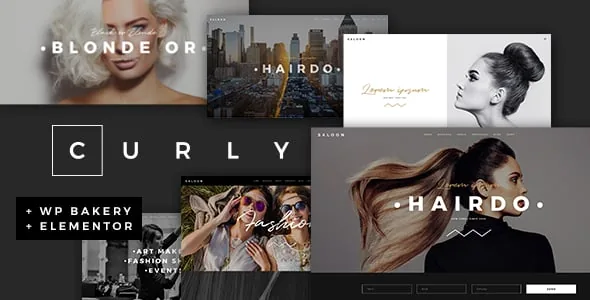

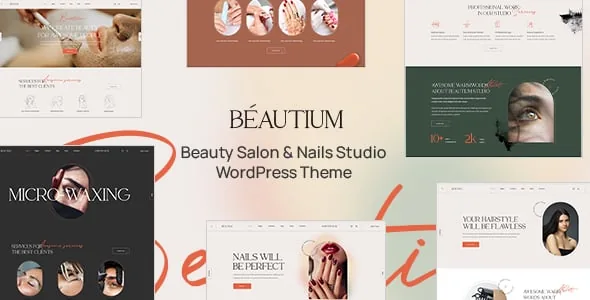

And now what the template listing does not tell you. Demo photographs are generally not included in the licence. That flawless manicure on the cover belongs to a stock library, and after installation there will be a grey rectangle in its place. The line saying whether images are included is on the template’s page — read it before buying.
Hence the arithmetic: a €50–80 template without your own photos of actual work does not function at all — for a salon that matters even more than for other kinds of business, because the portfolio is the offer. Budget time for shooting your own work straight away, not later. And second: the demo installs in one click and takes a week to clear out — somebody else’s services, prices and a dozen unneeded sections all have to come out by hand. How a theme differs from a set of sections, and what everything else costs, is covered in the guide to a micro-entrepreneur’s website.
Reviews: where to ask, and how to answer
The general procedure — how to ask for reviews without getting them deleted, how to answer bad ones — is covered in the Google Business Profile guide, including the ban on asking only satisfied clients. We will not repeat it.
What is specific to a salon is that a review is almost always about one specific practitioner, not the business as a whole. “The stylist didn’t listen to what I asked for” is a complaint about a named person, and it needs a more careful answer than “the café was cold”: any hint of publicly criticising a staff member reads worse than silence.
Second, in the beauty trade a review is often written not right away but a day or two later, once the colour or the manicure has “settled”. Do not rush the request on the way out — a short message the next day, asking to share an impression if they liked the result, works better.
Languages: the minimum for a foreign client
A full translation of the site is not needed for a small salon — the same rule as in the rest of this series applies: the minimum needed to decide, not a full copy in another language.
It is enough to translate the service list with prices, and how to book. Translate service names carefully: “balayage”, “brushing”, “modelage” are French beauty-trade terms that a foreign client living in France also sees written the same way at other salons, and machine translation distorts them.
What AI genuinely helps with, and where it does harm
For a salon, AI is useful exactly where it is for a café: where the cost of an error is zero.
Where it helps. Service descriptions: you dictate what is included and how long it takes, it turns that into a clear line for the client instead of “professional treatment”. Draft replies to reviews. Copy about the salon, its history, the team. Ideas for posts and seasonal offers — “pre-holiday treatments”, “summer manicure” — a month ahead. A first-draft translation of the service list.
Where it does not help. It knows neither your practitioners, nor your prices, nor what sets you apart from the salon down the road — and instead of saying “I don’t know”, it invents. A service description written entirely by a machine reads like any other salon’s.
Where it does outright harm. Wording that touches regulated terms — “massage” instead of “modelage” — never trust to AI: it does not know French beauty-trade regulation and will happily expose you to a complaint. The same goes for before/after photos: generated images of a result are a direct deception of the client, who will see one thing on the site and get another in the chair. And identical automated replies under every review are spotted at a glance.
The same rule as elsewhere in this series: AI can be trusted with form, never with facts. The moment a text touches price, qualification or result, you check it yourself. On the tools that assemble a whole site and where they bite, see the no-code guide.
What to check before launch
Go through this list yourself, and better still, ask someone who has never had their hair done at your salon to go through it too.
Prices decide, not vague words
Prices are compulsory, at least “from”, for every service separately. Their absence reads as “must be expensive, since they won’t say”, not as mystery.
Your own photos, and the client’s consent
The portfolio is a salon’s main argument, but a before/after shot needs the client’s written consent. A spoken “sure, go ahead” is not enough if it ever comes to a dispute.
Online booking with no fee per visit
A fixed subscription pays off with a steady stream of regulars; a commission-based platform suits a launch with no client base yet. Work it out on your own situation, not on how popular the service is.
Another common mistake: the word “massage” in an esthetician’s service description. It is reserved for qualified massage therapists; for a cosmetic treatment you write “modelage esthétique”. The Cour de cassation softened the rule in 2021 for wellness practices, but only where there is no confusion with therapeutic massage — which does not remove the need to check the wording on your own menu.
- The salon employs a qualified person, if it is a hair salon
- The esthetics service description does not use “massage” without grounds
- Before/after photos have the client’s written consent
- Service prices are shown at least as “from”
- Online booking works in one step from a phone
- The Google listing category is precise, not a generic “Beauty salon”
Webinkub does not replace legal, tax or immigration advice. When a question goes beyond the digital side, I say so and point you to an official source or a specialist.
Get in touch
Write to Webinkub
Send the link to your site or your profile — I’ll tell you what is holding the bookings back.
You might also like
Guide: a website for a café or restaurant
Menu in text, prices, opening hours, map, photos and booking: what a client must see in the first minute on a café or restaurant website.
Guide: a website for a micro-entrepreneur
What a micro-entrepreneur’s website needs: a clear service, a price, a location, a way to make contact and the mandatory pages. A practical guide.
Guide: Business Domiciliation — Who Can Use Their Home Address, and Who Can’t
Who can domicile their business at their home address, and who needs a domiciliation company: five legal options, the 5-year limit, the préfecture's approval, and real prices.