
CFE 2026: how much a micro-entrepreneur pays and how to check your tax notice
Since 2 November, 2026 CFE notices (cotisation foncière des entreprises, the local business tax) have been available in your professional account on impots.gouv.fr. They are not sent by post, and for many micro-entrepreneurs it is the first tax nobody warned them about. Here is what the amount depends on, who does not pay this year, how to check your notice and what to do if the figure looks wrong.
This is a news article. It explains the rules and is not tax advice. Checked against service-public.gouv.fr and impots.gouv.fr on 14 October 2026; links are at the end.
Do you have to pay this year?
You do not pay in 2026
- You started trading in 2026 (file form 1447-C-SD by 31 December)
- Your 2024 turnover was €5,000 or less and you have no business premises
- You started in 2025 and your 2025 turnover, scaled up to 12 months, was €5,000 or less
- Your activity is exempt by law (see the list below)
You pay a reduced amount
- You started in 2025: the base is halved
You pay in full
- You have been trading since 2024 or earlier and your 2024 turnover (scaled up to 12 months) was over €5,000
The €5,000 threshold is checked against your turnover from two years earlier (2024 for the 2026 tax) or, if you started in 2025, against your 2025 turnover. The exemption only covers the minimum contribution: if you have your own premises, they are still taxed. If your first year (2024 or 2025) was a partial year, your turnover is scaled up to 12 months: €3,000 earned in six months counts as €6,000 a year for the tax office, and the exemption no longer applies.
Exemptions based on your activity generally do not depend on turnover (the exception is VDI). Among those who do not pay CFE: graphic designers whose work is limited to creating graphic works (as service-public interprets it, under artiste-auteur status); photographers working as authors (taking pictures and licensing the rights); private tutors teaching school subjects or the arts who give the lessons themselves, at home, at the pupil’s home or in premises without a sign; painters, sculptors and illustrators who sell only their own work; and independent home sellers (VDI) earning up to €7,930 a year. The full list is in articles 1457 and 1460 of the French tax code (CGI) and on the service-public page (link at the end). If you are on this list and still received a notice, you have grounds to file a claim with the tax office.
How the amount is calculated
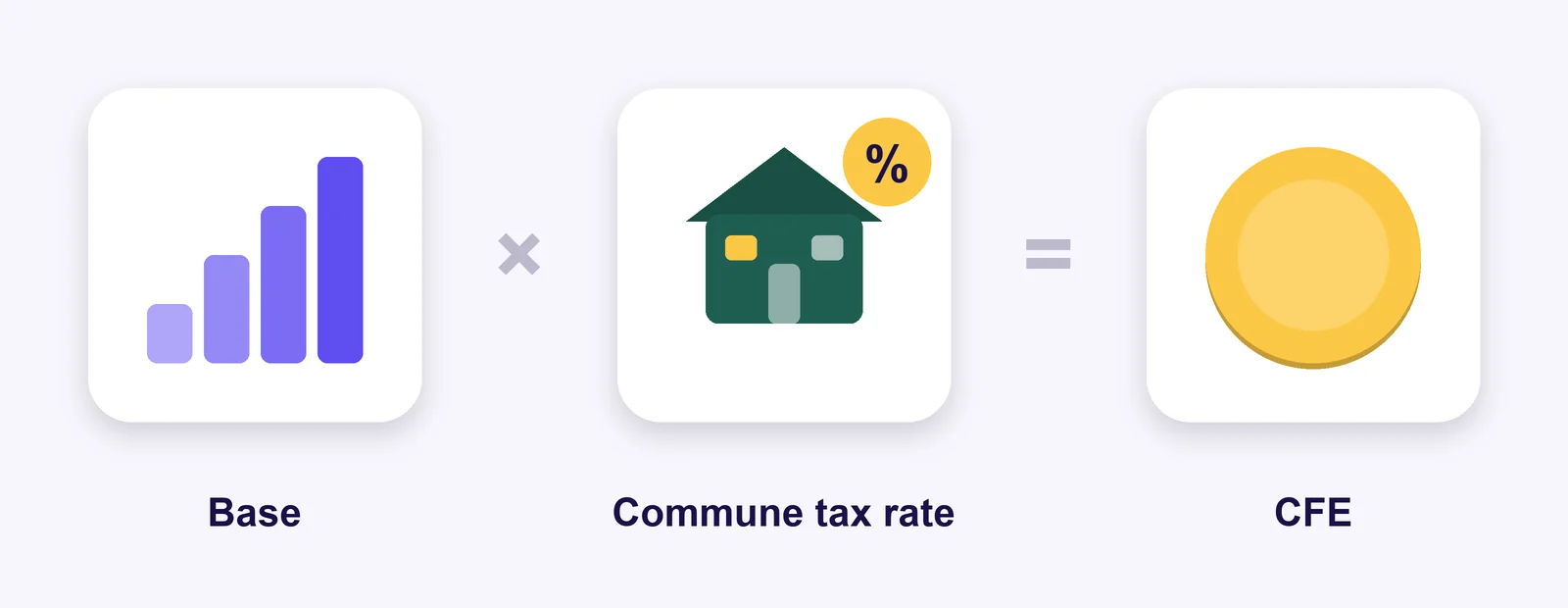
The base. Most micro-entrepreneurs have no business premises: they work from home or at clients’ sites. In that case the tax is calculated on a minimum base (base minimum), which the commune sets within a bracket that depends on your 2024 turnover:
| 2024 turnover (excl. VAT) | Minimum base in 2026 |
|---|---|
| up to €10,000 | €250 to €597 |
| €10,001 – €32,600 | €250 to €1,194 |
| €32,601 – €100,000 | €250 to €2,509 |
| €100,001 – €250,000 | €250 to €4,183 |
The rate. It is set by the commune (or a group of communes) and varies from town to town. What counts is the commune where your business is registered: your home or your domiciliation address. Domiciled in Paris but living in the suburbs? The Paris rate applies (more in our domiciliation guide). The notice shows the base, the rate and the tax, plus small management fees (frais de gestion), which are also listed. If you have your own premises, the tax is based on their rental value as assessed by the tax office, but never on less than the minimum base in the table, so the bill can be higher.
The chamber of commerce surcharge (taxe additionnelle CCI) for traders and craft micro-entrepreneurs (for craftspeople, the CMA chamber of trades surcharge) is paid to Urssaf with your turnover declaration — there is nothing to pay separately.
How to check your notice
- Find it in your professional account (espace professionnel) on impots.gouv.fr — not in your personal account (espace particulier) and not in your Urssaf account. In 2026 the notices appeared on 2 November. No professional account yet? Create one on impots.gouv.fr with your SIREN number. The activation code arrives by ordinary post at your business address, so start now: the letter takes several days and payment is due by 15 December.
- Check the commune: it must match your business address on 1 January 2026 (your home or domiciliation address). If you moved before that date and the tax was calculated for your old commune, you have grounds for a claim. If you moved during 2026, the 2026 CFE is correctly charged at the old address, and in the year of the move you need to file form 1447-C-SD for the new one.
- Check your start year. If you started in 2026 and still got a notice, the tax office has not taken your first year into account. Send a claim (réclamation) to the business tax office (SIE) through the secure messaging in your account, attaching your SIRENE registration statement (avis de situation) showing your start date. This does not replace form 1447-C-SD: that is filed separately with the SIE by 31 December, by post or through the secure messaging of your professional account.
- Check your turnover. If your 2024 turnover (2025 if you started in 2025) was €5,000 or less and you have been charged, write to the SIE through the secure messaging, attaching a statement of your turnover declarations from your Urssaf account.
Filing a claim does not suspend the payment deadline: if the amount is disputed, pay on time and ask for a refund — or explicitly request, in the claim itself, a deferral of payment until a decision is made. You can file a claim about your 2026 CFE until 31 December 2027.
Payment: by 15 December
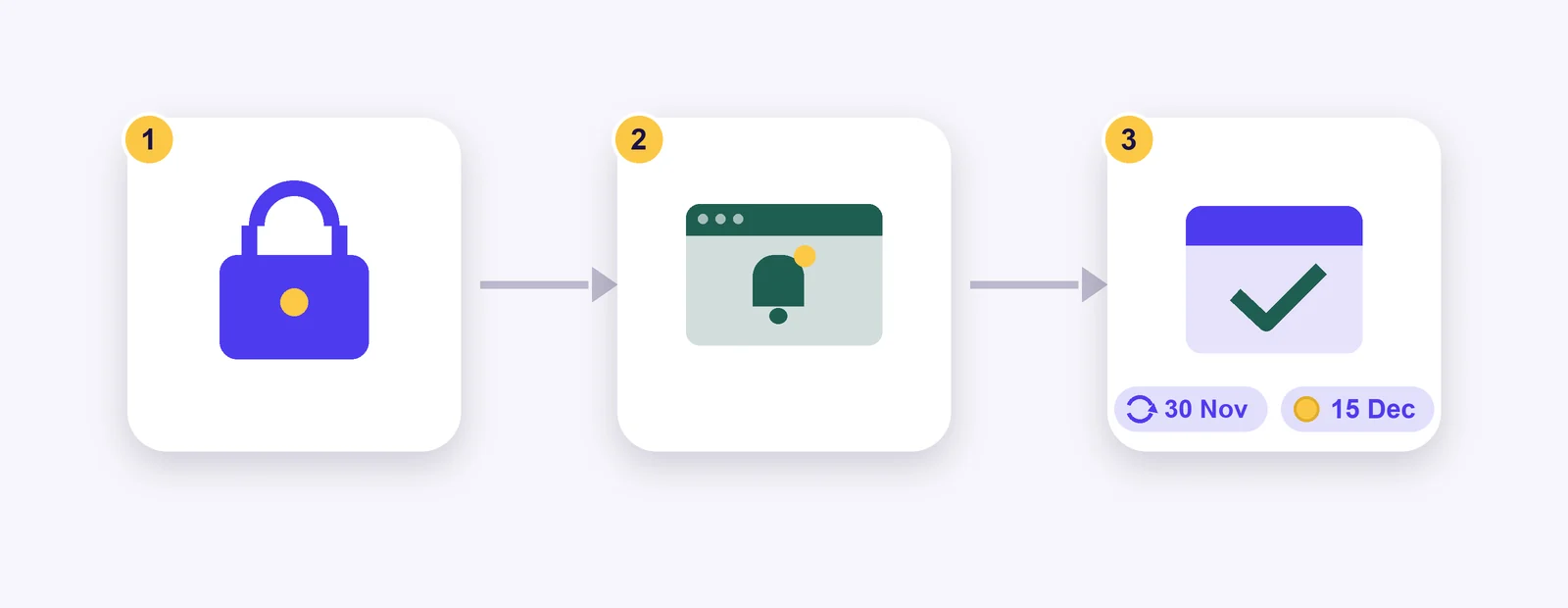
- Deadline: 15 December 2026 inclusive, online only — from your account or by direct debit. Cheques and cash are not accepted. Paying late adds a 5% surcharge.
- Direct debit on the due date (prélèvement à l’échéance, the money is taken after 15 December): sign up by 30 November in your account or by phone on 0809 401 401.
- Monthly direct debit. If you want to pay your 2027 CFE in instalments, sign up in your account by 15 December 2026: ten payments will then be taken from 15 January to 15 October, each one a tenth of the previous year’s CFE, with a balancing adjustment in December. Sign up between 16 and 31 December and the payments start in February, including a catch-up for January. Useful if the amount is large.
All the November deadlines in one place: our November calendar. Why CFE so often catches people off guard: see our guide to micro-entrepreneur surprises, point 3.
Rules checked on 16 October 2026; notice date and payment deadline checked on 6 November 2026. Sources: service-public, CFE (checked by the administration on 2 April 2026, 2026 base table); impots.gouv.fr: 2026 CFE notices, monthly direct debit, claim deadline; articles 1457 and 1460 of the French tax code (exemptions), article 1647 D (minimum base), articles 1731 and 1731 B (5% surcharge). Only your own notice shows the exact amount.
Does the amount on your notice look odd?
Send me your notice with personal details removed, plus your start date and turnover. I’ll tell you whether it’s worth filing a claim with the tax office.
Want your whole situation looked at?
Mentoring covers the whole path: from registration to reporting and choosing your tools.
You might also like
Micro-entrepreneur calendar: what to do in November 2026
November 2026 for micro-entrepreneurs in France: DES by the 13th, CFE notice and direct debit by the 30th, October declaration, 2026 starters.
Guide: micro-entrepreneur surprises — 10 things people find out too late
A customs filing when your client is an EU company, CFE with no paper notice, VAT you owe on Google Ads, a fine for a zero declaration: ten micro-entreprise duties people learn about too late.
Guide: Business Domiciliation — Who Can Use Their Home Address, and Who Can’t
Domicile your business at home or use a domiciliation service: five legal options, the 5-year home-address limit, préfecture approval (agrément) and real prices.