
Your first invoice as a micro-entrepreneur: the 12 mandatory details, with a template
Your first client said yes and the job is done — now you need to invoice. In France an invoice (facture) must carry certain mandatory details, and each missing one can cost you a fine. We go through them in order on a template, then explain when an invoice is compulsory, which payment terms to state, how to bill a client in another EU country and how to fix a mistake without breaking your numbering.
This guide explains the rules; it is not a substitute for advice from an accountant. Checked against service-public.gouv.fr, Légifrance and BOFiP (the official tax guidance) on 14 October 2026; links are at the end. It covers micro-entrepreneurs who do not charge VAT (franchise en base de TVA), which is most of them.
When an invoice is mandatory
Business client
- An invoice is always required, for every sale and every service
- Issue it as soon as you deliver or finish the work
Private client, services
- Required above €25 including tax
- Below that, if the client asks for one
Private client, goods
- If the client asks for one
- Required for distance selling (online shop)
If you work for the same client regularly, you can issue one summary invoice per month (facture récapitulative), no later than the last day of the month. Even when an invoice is not required, every sale still goes into your sales ledger (livre des recettes) — more on that below. Payment on a summary invoice is due within 45 days of issue at most.
The template: 12 lines in order
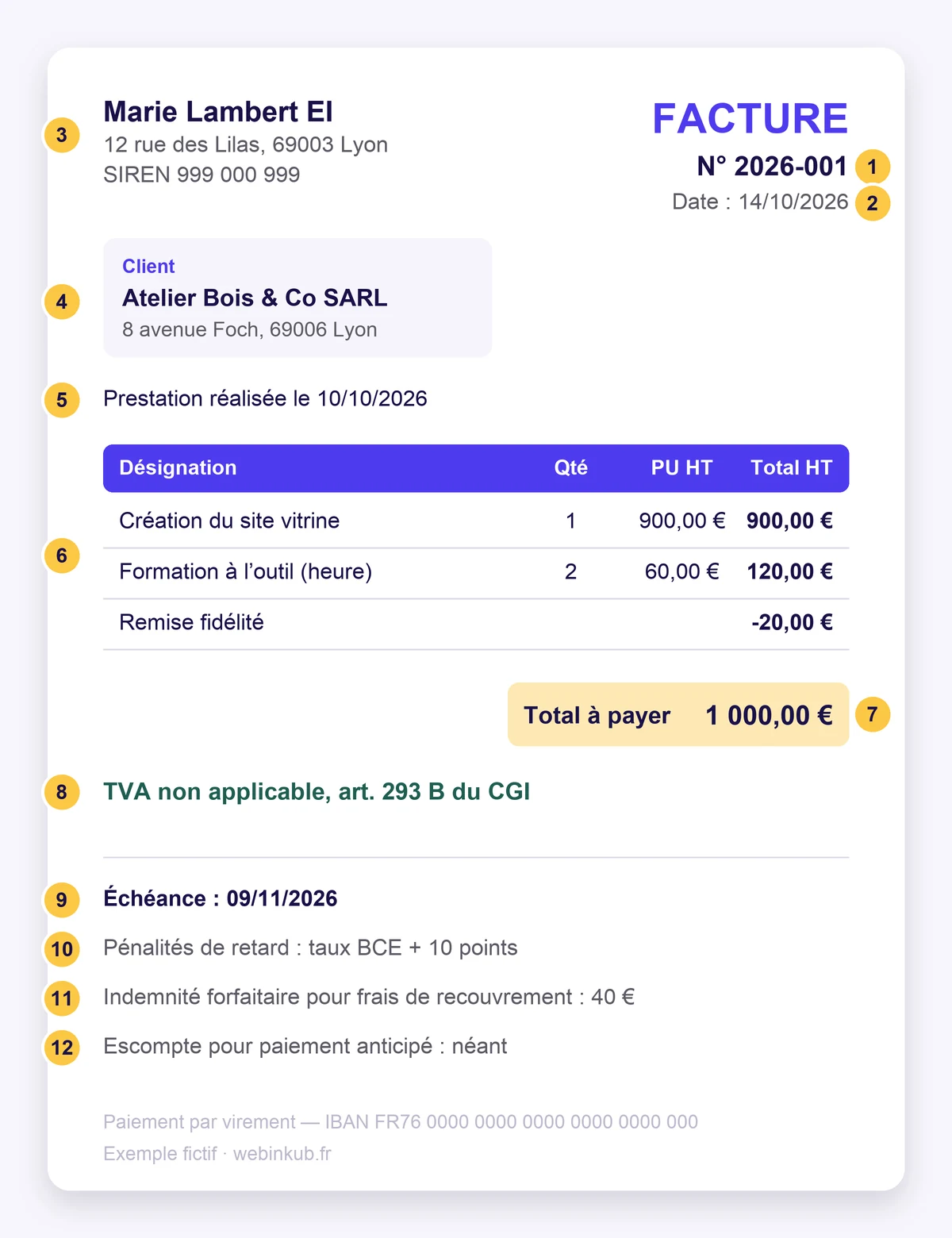
- Invoice number. Unique, sequential and with no gaps: 2026-001, 2026-002… Including the year is practical, but the sequence must still be unbroken. Separate series (for example for two activities, or for credit notes: A2026-001) are allowed if your business justifies them.
- Date of issue.
- You: first name and surname followed by EI or “Entrepreneur individuel” (mandatory since 15 May 2022), address, your nine-digit SIREN and your business’s SIRET (the SIREN plus five digits for the address). Both appear on your INSEE registration notice (avis de situation) and on annuaire-entreprises.data.gouv.fr. If your number has not arrived yet, it is best to wait for it — usually one to four weeks; in practice people write “Siret en cours d’attribution”. If you sell goods and are on the trade and companies register, add “RCS” and the town of the registry after your SIREN. Tradespeople whose trade requires insurance must state it: the insurer and the geographical area covered (for builders, the ten-year décennale cover).
- Client: name or company name and address, plus the billing address if different. From 1 September 2027, a business client’s SIREN will also be required.
- Date of the service or delivery, if it differs from the invoice date.
- What you sold: a clear description, quantity, unit price before tax (PU HT; HT means before tax, TTC including tax), any discounts. If the client gave you a purchase order number (bon de commande), include it.
- Total due. If you do not charge VAT, the pre-tax amount and the total are the same — leave out any “TVA” line.
- VAT statement: “TVA non applicable, art. 293 B du CGI” — it explains why there is no VAT on the invoice.
- Due date — a specific date (échéance).
- Late-payment interest (pénalités de retard) — the rate. You can write “taux BCE + 10 points”: this is the default rate, 12.40% in the second half of 2026.
- €40 recovery fee (indemnité forfaitaire pour frais de recouvrement) — on invoices to business clients only.
- Early-payment discount. If you do not offer one, you still write: “Escompte pour paiement anticipé : néant”.
Lines 9–12 are for invoices to business clients. For a private client, lines 1–8 are enough; the due date is optional, and late-payment interest and the €40 fee are left out. Bank details (IBAN) are not mandatory, but they make it easier for the client to pay.
If you sell certain goods to private clients (appliances, furniture and so on), mention the legal guarantee of conformity: at least two years. If you have an EU VAT number (TVA intracommunautaire), it goes on the invoice too.
Payment terms and late-payment interest
- By default, a business client pays within 30 days of the service or delivery, unless you agreed otherwise.
- You can agree on longer terms, but no more than 60 days from the invoice date or 45 days “end of month” (fin de mois) — that is the legal limit.
- Late-payment interest cannot be lower than three times the legal interest rate. If the contract says nothing, the ECB rate plus 10 points applies.
- The €40 recovery fee is due from the first day of delay, once per invoice. It does not apply to private clients.
With private clients, payment terms are whatever you agreed; they usually pay on the spot. The fixed €40 recovery fee does not apply to them.
Clients in another EU country
If you provide a service to a company in another EU country:
- the invoice is issued without VAT, with the same statement “TVA non applicable, art. 293 B du CGI”, plus the statement “Autoliquidation” (reverse charge — the client pays the VAT in their own country; required by article 242 nonies A of annex II to the CGI);
- you need an EU VAT number (TVA intracommunautaire), even though you do not charge VAT. You do not get one automatically: request it from your business tax office (SIE — service des impôts des entreprises) through the secure messaging in your professional account on impots.gouv.fr. It goes on the invoice together with the client’s VAT number;
- for every month in which you provided such a service, you file a DES return with French customs — step by step in our DES guide.
For a client outside the EU, the invoice is issued the same way, without VAT, and no DES is needed.
How to correct a mistake

Don’tOpen the old file, change the amount and send it again under the same number. Deleting the invoice and issuing another one with the same number is not allowed either: it leaves a gap or a duplicate in your numbering.
DoIf the invoice has not been paid, issue a new one with the next number and the words “annule et remplace la facture n° …”. If it has been paid, issue a facture d’avoir (a credit note for a refund or a reduced amount) with the next number, referring to the original invoice.
Common mistakes and fines
- VAT on the invoice when you are exempt. If you write “TVA 20%”, you owe that VAT to the tax office, and your client cannot reclaim it.
- No “EI” after your name.
- Gaps in the numbering — for example after a deleted invoice.
- No line about the early-payment discount or the €40 fee on an invoice to a business client.
The fines differ because the lines are required by two different codes. A missing or incorrect tax line (number, dates, parties, amounts, VAT statement) costs €15, capped at a quarter of the invoice amount; a first breach is not fined if there were no others in the current year or the three previous ones and you correct it yourself or within 30 days of being asked. Leaving out lines 9–12 on an invoice to a business client, or not issuing an invoice at all, breaches the Commercial Code: a fine of up to €75,000 for a sole trader.
Record-keeping
- Keep invoices for 10 years, on paper or electronically.
- The sales ledger (livre des recettes) is mandatory for all micro-entrepreneurs: date, client, amount, payment method, invoice number. A spreadsheet will do, or invoicing software that keeps it for you.
- The purchase register (registre des achats) — if you sell goods or let accommodation.
- The total in your sales ledger is what you declare to Urssaf; how the online account works is covered in our Urssaf guide.
A quote (devis) is not the same thing
A quote is an offer made before the work; an invoice is issued afterwards. A quote becomes binding on the client once signed with the words “bon pour accord”. For some work it is required by law: building and renovation, removals, home services (services à la personne: cleaning, childcare, help at home) from €100 a month, and a few others. Not providing a mandatory quote can cost up to €3,000. Invoices and quotes are numbered in separate series.
What changes in 2027
- From 1 January 2027, VAT rules move to a new code (the CIBS), and the article on the VAT exemption gets a new number. You can keep the usual “art. 293 B du CGI” statement on your invoices until 30 June 2028 — no need to rush to change your template. Service-public still shows the old dates (1 September 2026 and 31 December 2027): they were pushed back in July 2026, and the current ones are in the BOFiP guidance.
- Already in force: since 1 September 2026, every business must be able to receive e-invoices — which requires an approved platform.
- From 1 September 2027, invoices to business clients in France can only be issued electronically through an approved platform, with new lines: the client’s SIREN, the delivery address and the nature of the transaction. Details in our e-invoicing news article.
Other surprises awaiting micro-entrepreneurs are covered in our guide to the surprises.
Correct as of 14 October 2026. Sources: service-public, invoicing rules (checked by the administration on 7 August 2026); mandatory invoice details; payment terms; services to EU clients; sales ledger; article 242 nonies A of Annex II and article 1737 of the French Tax Code; articles L441-9, L441-10, D441-5 and R526-27 of the Commercial Code; BOFiP on the switch to the CIBS.
Want a template that fits your business?
Tell me what you do and who your clients are. I’ll help you put together an invoice template and choose software that handles numbering and your income ledger for you.
Want your whole situation looked at?
Mentoring covers the whole path: from registration to reporting and choosing your tools.
You might also like
Guide: micro-entrepreneur surprises — 10 things people find out too late
A customs filing when your client is an EU company, CFE with no paper notice, VAT you owe on Google Ads, a fine for a zero declaration: ten micro-entreprise duties people learn about too late.
E-invoicing: micro-entrepreneurs must issue e-invoices from 1 September 2027. What to do before then
From 1 September 2027, French micro-entrepreneurs must e-invoice business clients and report sales data, even if VAT-exempt. Fines and a plan.
DES: How to File the EU Services Declaration with French Customs
Who must file the DES for EU business clients, how to register on douane.gouv.fr and submit the declaration — step by step, with screenshots.