
E-invoicing: micro-entrepreneurs must issue e-invoices from 1 September 2027. What to do before then
Since 1 September 2026, every business in France has had to be able to receive electronic invoices. Exactly a year later, on 1 September 2027, the second stage of the reform kicks in: micro-entrepreneurs start issuing them and reporting their sales data to the tax authorities. Here is what will change in your day-to-day work, what the penalties are and what to do over the remaining 11 months so you are not scrambling in the last week of August.
This is a news article. It explains the rules and deadlines and is not tax or accounting advice. Checked against service-public.gouv.fr, BOFiP (the official tax guidance) and Légifrance on 16 October 2026; links are at the end.
Where things stand

- Receiving is already compulsory. Since 1 September 2026, every business — including micro-entrepreneurs and those who do not charge VAT (franchise en base, the VAT exemption scheme for small businesses) — must have a platform to receive e-invoices. How to choose one: see our September news article.
- No penalties in 2026. The minister announced on 1 September that no penalties would be applied in 2026. This is not a postponement: the obligation to receive e-invoices already applies. From January 2027, the tax office can formally require you to sign up to a platform and fine you if you have not done so within 3 months. The “no penalties in 2026” promise is a ministerial statement, not a rule written into law.
- The 1 September 2027 deadline stands. It is set in law (the 2024 Finance Act, article 91) and repeated in the tax authorities’ official guidance (BOFiP of 30 September 2026). A bill for a moratorium for micro-entrepreneurs and small businesses (no. 3135) has been tabled in the National Assembly, but it has not been passed. Plan as if the date will not move.
What changes on 1 September 2027
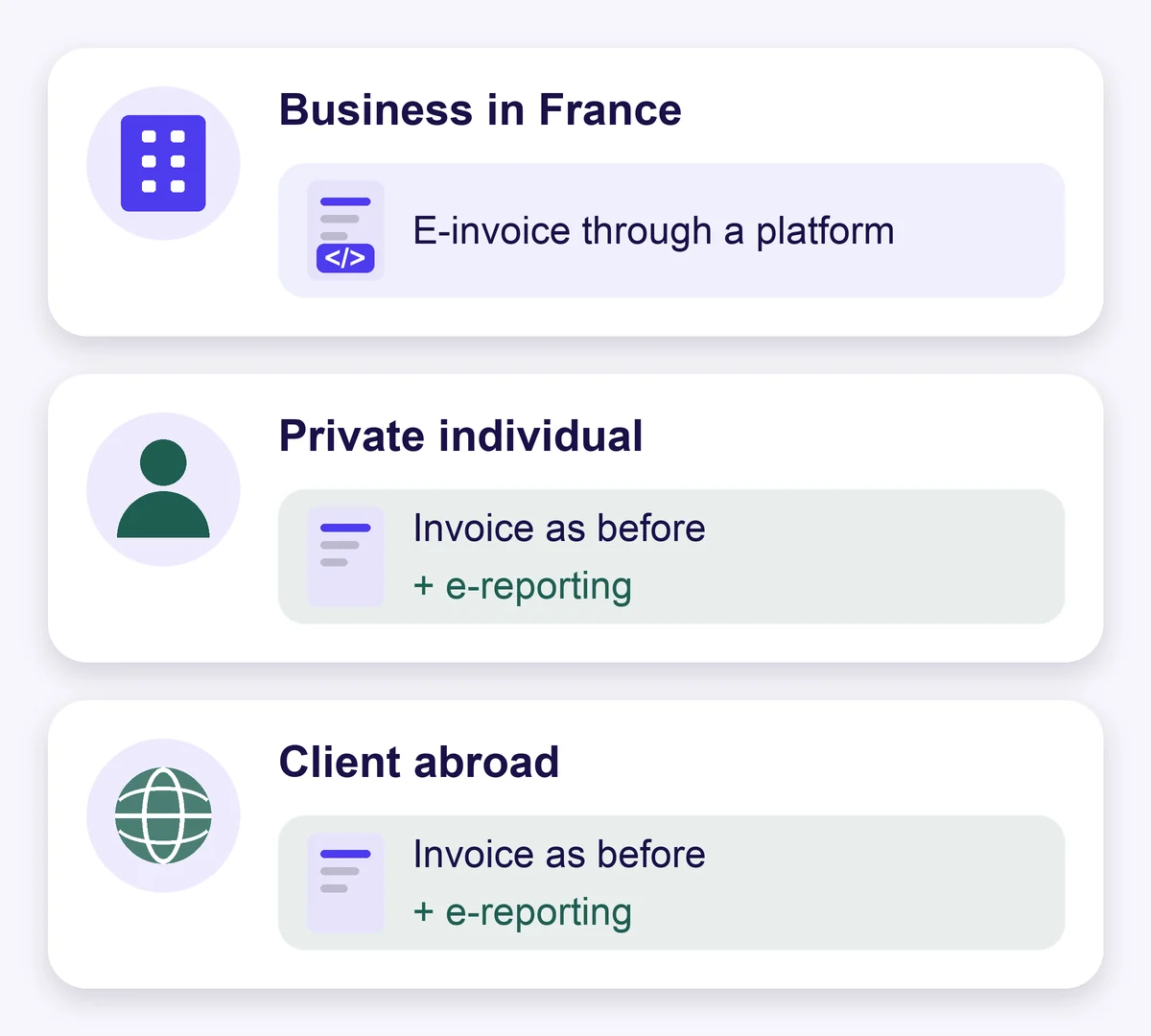
It all depends on who you are invoicing.
Client: a business in France
- A company or another self-employed person, micro-entrepreneurs included
- E-invoice only, through a platform
- A PDF sent by email no longer counts as an invoice
Client: a private individual
- You can invoice as you do now
- Plus sales data sent to the tax office every two months (under VAT exemption)
Client abroad
- You can invoice as you do now
- Plus sales data sent to the tax office every two months (under VAT exemption)
What an e-invoice is. Not a PDF or a scan, but a file in a machine-readable format (UBL, CII or Factur-X — a PDF with the same data embedded) that reaches your client through an approved platform (plateforme agréée). Your client still sees a familiar-looking document. You do not build the file yourself: the platform, or invoicing software connected to it, does that.
What e-reporting is. It means sending the tax office data on sales that do not go through an e-invoice: sales to private individuals and to clients abroad. For sales to individuals, you send not the invoice itself but a daily summary (amounts by VAT rate and dates); for foreign companies, the data from each invoice. If you do not charge VAT (franchise en base), you send the data every two months, and if you had no such sales, there is nothing to send. It is usually done by the same platform, for invoices you issued there. Whether you also have to report payments received for services is not clearly stated in the official texts for VAT-exempt businesses: check with your platform.
E-reporting does not replace your turnover declaration to Urssaf. They are two separate obligations, and one does not cancel the other.
Whoever your clients are: if you buy services from foreign companies — Google or Meta ads, foreign online tools — data on those purchases is reported too. Why such purchases matter to the tax office at all: see our guide to micro-entrepreneur surprises, point 2.
Frequently asked questions
- Your client is a town hall, a school or another public body. E-invoicing has long been compulsory for them, via the government portal Chorus Pro. Nothing changes here.
- Your client is an association. If it carries out no activity subject to VAT (non assujettie), it does not count as a business for the reform: you invoice it like a private individual and the data goes through e-reporting. If the association is under franchise en base (liable for VAT in principle but not charging it), the invoice must be electronic, as for a business.
- Your activity is VAT-exempt by law (some healthcare, education and similar activities, articles 261 to 261 E of the French tax code): these transactions fall outside the reform — no e-invoice and no e-reporting. Franchise en base is something else: it does not take you out of the reform.
- Your business client does not know its SIREN number. Look it up by name on annuaire-entreprises.data.gouv.fr, the free official business directory.
- A deposit invoice (facture d’acompte) to a business client in France must also be electronic.
New details on your invoices
From 1 September 2027, four new mandatory details appear on micro-entrepreneurs’ invoices. Invoicing software will add the fields, but you need to gather the information in advance:
- The client’s SIREN, the nine-digit business number. Without it, the e-invoice cannot reach its recipient. Start collecting your regular clients’ numbers now.
- The delivery address, if it differs from the client’s address.
- The type of transaction: goods, services or both.
- The note “option pour le paiement de la taxe d’après les débits” — only if you charge VAT and have chosen this option. Under franchise en base it does not apply to you.
Also worth knowing: on 1 January 2027 the VAT rules move from the French tax code (CGI) to the code of taxes on goods and services (CIBS), in force since 2022. The usual wording “TVA non applicable, art. 293 B du CGI” can stay on your invoices until 30 June 2028, so there is no need to rush to change your template.
Penalties
| Breach | Fine |
|---|---|
| Invoice to a business client not issued electronically | €50 per invoice, up to €15,000 a year |
| Sales data (e-reporting) not sent | €250 per missed submission, up to €15,000 a year (wording in force from 1 January 2027; it was €500 in 2026) |
| No platform to receive invoices | formal notice and 3 months to comply → €500; further notice → €1,000 for each subsequent 3-month period |
A first breach on invoices or e-reporting is not fined if there were no others that year or in the previous three years and you corrected it yourself or within 30 days of the tax office’s request. This does not apply to having no platform to receive invoices: there you are fined if you do not comply with the formal notice within 3 months. The 2026 Finance Act raised the per-invoice fine from €15 to €50. The same act raised the data fine to €500, but from 1 January 2027, after the VAT rules moved to another code, the text says €250 again — the 2027 Finance Act may fix this, and we are keeping an eye on it.
Your 11-month plan
- Before the end of 2026: a platform to receive invoices. If you have not chosen one yet, do it now — it has been compulsory since September, and the penalty-free year ends on 31 December. How to choose: see our September news article.
- Check that your platform can issue invoices and handle e-reporting. In 2026 some services had only set up receiving. You can switch platforms at any time: the switch takes up to 15 working days after your old platform agrees, so allow a month — and not in August 2027.
- Winter 2027: collect the SIREN numbers of your regular business clients and sort your clients into three groups: businesses in France, private individuals, clients abroad.
- Spring 2027: move your invoicing to the platform or to software connected to it. Invoicing private individuals there too makes life easier — e-reporting then happens automatically.
- Summer 2027: send a test e-invoice to a business client you know well and check that it arrived.
- 1 September 2027: e-invoices only for business clients in France. No more PDFs by email.
Questions about the reform: the tax authorities’ helpline on 0 806 807 807 (free service, standard call rates apply). Other obligations that are easy to miss are covered in our guide to micro-entrepreneur surprises.
Information correct as of 16 October 2026. Sources: service-public, e-invoicing (checked by the administration on 7 August 2026); service-public, news on the timetable; mandatory invoice details; order of 27 July 2026 (formats and dates); BOFiP, e-reporting; article 1737 and article 1788 D of the French tax code (fines); ministry press release of 1 September 2026; bill no. 3135. The reform timetable has been pushed back before, so check the official sources before acting.
Not sure where to start?
Tell me who you invoice and how many invoices you send a month. I’ll tell you what to check on your platform and how to move your clients over before September 2027.
Want your whole situation looked at?
Mentoring covers the whole path: from registration to reporting and choosing your tools.
You might also like
E-invoicing: from 1 September 2026 everyone must be able to receive them, micro-entrepreneurs included
Facture électronique from 1 September 2026: every French business must receive e-invoices. What micro-entrepreneurs must do, deadlines, which platform to pick.
Guide: micro-entrepreneur surprises — 10 things people find out too late
A customs filing when your client is an EU company, CFE with no paper notice, VAT you owe on Google Ads, a fine for a zero declaration: ten micro-entreprise duties people learn about too late.
CFE 2026: how much a micro-entrepreneur pays and how to check your tax notice
CFE 2026 in France: what the amount depends on, the minimum base by turnover, who is exempt, paying by 15 December and checking your notice.